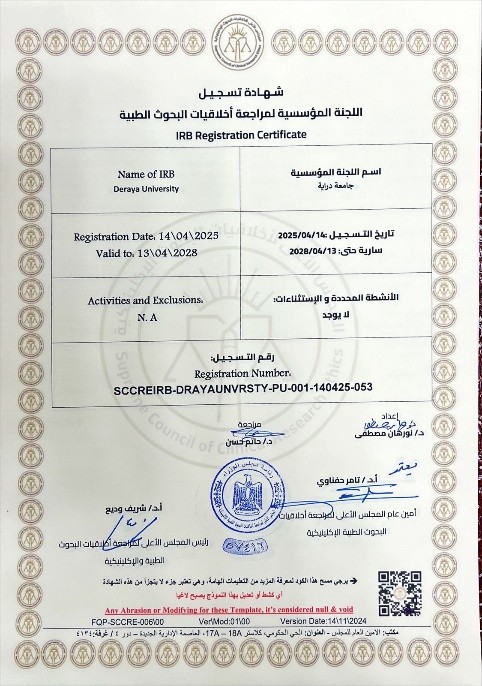
DCSR is the university’s hub for research quality, training and collaboration. It helps faculty and students design studies, secure ethics approval, publish in high-impact journals and protect their inventions, and it opens Deraya’s laboratories to partners across Upper Egypt.
Contact research@deraya.edu.eg
To be a leading and distinguished research office regionally, fostering innovation and advancing the level of scientific research through building outstanding research capacities and providing an attractive environment for researchers; renowned for its innovative applied research and effective partnerships with industrial and societal sectors.
The office strives to support and develop scientific research and innovation by providing an integrated and stimulating research environment for researchers, facilitating their access to the latest research facilities, and ensuring the highest standards of research quality, ethics, and intellectual property protection. The office is committed to strengthening effective partnerships with academic and industrial sectors and disseminating high-impact knowledge, thereby contributing to the production of applied research with tangible social and economic impact, and enhancing the university’s position as a leading scientific institution at the regional level
Strategic Objectives
Achieve excellence and innovation in research to attract researchers of high potential and provide the chance for students and researchers from Egypt and neighboring countries to pursue their research at international standards
Increase the number of publications in high-impact scientific journals.
Provide training and continuous improvement for academic staff to ensure the highest performance standards of research output.
Foster a new generation of multidisciplinary researchers prepared to compete and excel in dynamic environments.
Research Strategy
Carpal Tunnel Syndrome (CTS) represents the most common form of peripheral nerve
neuropathy of the upper limb. It results in pain, numbness, and limitation of function, especially affecting
ADL activities. Conservative management includes physiotherapy, splinting, and activity modification,
while corticosteroid injections and surgery are invasive or minimally invasive options. As artificial
intelligence (AI) becomes increasingly common in healthcare, novel approaches to improve diagnosis,
treatment precision, and rehabilitation effectiveness.
Review TeStress urinary incontinence (SUI) and nonspecific low back pain (NSLBP) are prevalent conditions that significantly affect women's quality of life. Recent studies have identified a connection between these conditions and dysfunction in the peripheral nerves of the lower limb. This study aims to compile existing knowledge on the electrophysiological findings in the peripheral nerves of the lower limb in women experiencing SUI and NSLBP. This was a prospective observational study involving fifty healthy women and women suffering from SUI and NSLBP. The participants were aged between 25 and 35 and had a body mass index (BMI) ranging from 20 to 24. The primary outcome measures focused on evaluating lower-limb peripheral nerves in women with SUI and NSLBP. There was an increase in both distal and proximal latencies of the tibial nerve, along with a significant decrease in distal and proximal amplitudes and nerve conduction velocity (NCV) in group A when compared to group B (p < 0.001). For the peroneal nerve, group A showed a significantly higher distal latency and a significantly lower NCV (p 0.05). Regarding the sural nerve, group A had significantly higher onset latency and lower amplitude and NCV compared to group B (p < 0.01). These findings reveal statistically significant nerve conduction abnormalities in tibial, peroneal, and sural nerve conduction in women suffering from stress urinary incontinence (SUI) and non-specific low back pain. The tibial nerve displayed extended distal and proximal latencies, diminished amplitudes, and lower nerve conduction velocity (NCV). The peroneal nerve showed prolonged distal latency and a reduced NCV, while the sural nerve had an extended onset latency, decreased amplitude, and slower NCV. The tibial nerve showed the most changes, including extended latencies and lower conduction velocity, implying both axonal and demyelinating involvement. These changes, supported by large effect sizes, high thresholds commonly associated with clinically meaningful decline, and may have functional consequences.
Recent research examines the impact of managerial overconfidence on financial performance in the banking sector,focusing on 17 Egyptian banks over six years. Managerial overconfidence, characterized by an excessive belief in one’s decisionmaking abilities, often influences critical financial decisions such as investment strategies, risk management, and resource allocation. The research adopts a quantitative approach, utilizing regression and correlation analyses to investigate the relationship between managerial overconfidence and key financial performance indicators, including Return on Equity (ROE), Return on Assets (ROA), and Leverage. The findings reveal a statistically significant negative relationship between managerial overconfidence and ROE, suggesting that overconfident decisions may harm shareholder returns. Additionally, while the relationship with ROA and Leverage was
observed, it lacked statistical significance, indicating the need for further investigation. The results emphasize the potential risks of overconfident
managerial behavior, particularly in volatile financial environments, while highlighting the importance of balanced and data-driven decision-making. The study also acknowledges limitations such as the geographic scope, sample size, and reliance on secondary data, which may affect the generalizability of the findings.
| Bacterial Strain | ATCC No. |
|---|---|
| Enterobacter cloacae | ATCC ® 23355 |
| Enterococcus casseliflavus | ATCC ® 25788 |
| Enterococcus faecalis | ATCC ®29212 |
| Escherichia coli | ATCC ®25922 |
| Klebsiella pneumonia | ATCC ®13883 |
| Staphylococcus aureus | ATCC ®25923 |
| Methicillin resistant Staphylococcus aureus (MRSA) | ATCC ®43300 |
| Pseudomonas aeruginosa | ATCC ®27853 |
| Streptococcus pyogenes | ATCC ®19615 |
| Vancomycin resistant Enterococcus faecalis | ATCC ®49532 |
| ESBL Klebsiella | Clinically isolated strains |
| Carbapenem resistant Klebsiella | Clinically isolated strains |
| Proteus vulgaris | Clinically isolated strains |
| Proteus mirabilis | Clinically isolated strains |
| Bacillus subtilus | Clinically isolated strains |
| Candida albicans | Clinically isolated strains |
Find us: Pharmacy College, College of Pharmacy, 3rd floor, Lab 305, Deraya University, Deraya Square, New Minya, Egypt.
Email: DCRL@deraya.edu.eg
Phone:-01000121593
Operating Hours: We are open from Saturday to Wednesday, 9:00 A.M – 4:30 P.M. (Closed on weekends and public holidays).